

A mortgage application usually takes 30 to 60 days from full application to closing, but the exact timeline depends on your lender, your documents, the property, the appraisal, the title search, and how quickly underwriting conditions are cleared.
Some borrowers move through the process in about 30 days. Others need closer to 45 or 60 days, especially if their income is complex, the appraisal is delayed, or the lender asks for extra documents. The important thing to understand is that a mortgage application is not just one form. It is a full review of your income, credit, debt, assets, property value, title status, insurance, and closing documents.
The good news is that many delays are avoidable. If you prepare documents early, respond quickly, avoid new debt, and stay in contact with your lender, you can make the process smoother and faster.
Quick Answer: How Long Does a Mortgage Application Take?
Most mortgage applications take about 30 to 60 days from the time you submit a full application to the day you close on the loan.
Here is the simple version:
| Mortgage Stage | Typical Timeframe | What Happens |
|---|---|---|
| Pre-approval | Same day to 3 days | Lender reviews basic credit, income, assets, and debt |
| Full application | 1 to 3 days | You submit detailed personal, financial, and property information |
| Loan Estimate | Within 3 business days | Lender gives estimated loan terms and closing costs |
| Processing | 3 to 10 days | Loan processor organizes and checks your file |
| Appraisal | 1 to 2 weeks | Property value is reviewed |
| Underwriting | A few days to several weeks | Lender checks borrower risk and loan eligibility |
| Conditional approval | A few days to 2 weeks | You clear remaining lender conditions |
| Clear to close | 1 to 3 days | Lender confirms the file is ready |
| Closing Disclosure review | At least 3 business days | You review final loan terms before signing |
| Closing day | 1 day | Final documents are signed and funds are transferred |
So, when people ask, “How long does a mortgage application take?” the best answer is:
Plan for 30 to 60 days, but your preparation can make a big difference.
Mortgage Pre-Approval vs Mortgage Application
Before looking at the full timeline, it helps to understand the difference between mortgage pre-approval and a full mortgage application.
A pre-approval is an early review. The lender checks your financial profile and gives you an estimate of how much you may be able to borrow. This can help you shop for homes with more confidence.
A full mortgage application is more detailed. It usually happens when you are ready to move forward with a specific property or loan. At that point, the lender reviews both you and the property.
Mortgage pre-approval may include:
- Credit check
- Income review
- Employment information
- Bank account review
- Estimated loan amount
- Estimated monthly payment
- Debt-to-income review
A full mortgage application may include:
- Full borrower details
- Property address
- Purchase agreement
- Down payment information
- Appraisal
- Title search
- Homeowners insurance
- Underwriting
- Closing documents
Pre-approval can be fast, but it does not guarantee final approval. The lender still needs to verify the property, review title details, check final documents, and confirm that your finances have not changed.
Step-by-Step Mortgage Application Timeline
The mortgage process becomes easier to understand when you break it into stages.
Step 1: Submitting the Mortgage Application
The first official step is submitting your mortgage application. This may take a few hours if your documents are ready, or a few days if you still need to gather information.
Your lender will usually ask for:
- Full legal name
- Date of birth
- Social Security number or tax identification details
- Employment history
- Income information
- Bank account details
- Monthly debts
- Credit authorization
- Property address
- Purchase price
- Down payment amount
- Loan type
- Co-borrower information, if applicable
Accuracy matters at this stage. A small mistake in income, address, employment history, or asset information can create delays later.
For example, if your bank statement shows a large deposit and the lender does not know where it came from, they may ask for proof. If your application lists income that does not match your pay stubs, underwriting may request an explanation.
Step 2: Receiving the Loan Estimate
After you submit a mortgage application, the lender provides a Loan Estimate. This document shows the estimated cost and structure of your loan.
A Loan Estimate usually includes:
- Estimated interest rate
- Monthly principal and interest payment
- Estimated taxes and insurance
- Closing costs
- Loan fees
- Cash needed to close
- Whether the rate is fixed or adjustable
- Whether there is a prepayment penalty
- Whether there is a balloon payment
This is one of the most important documents in the mortgage process. It helps you compare loan offers and understand what the mortgage may actually cost.
You should review:
- Interest rate
- APR
- Monthly payment
- Estimated closing costs
- Cash to close
- Origination charges
- Discount points
- Estimated taxes and insurance
Do not only compare the monthly payment. A loan with a slightly lower payment may have higher upfront costs. A loan with lower closing costs may have a higher rate. Look at the full picture.
Step 3: Loan Processing
After the application is submitted, your loan usually moves into processing.
A loan processor organizes the file before underwriting. This person checks whether the lender has the documents needed to review your loan.
The processor may:
- Review pay stubs
- Check W-2s or tax returns
- Review bank statements
- Confirm employment details
- Order the appraisal
- Coordinate title work
- Check homeowners insurance requirements
- Flag missing information
- Prepare the file for underwriting
Processing can be quick when the borrower has a simple financial profile. It can take longer if the borrower is self-employed, has multiple income sources, owns rental properties, or has large unexplained deposits.
Step 4: Home Appraisal
The appraisal is one of the most common reasons a mortgage application takes longer than expected.
The lender wants to confirm that the property is worth enough to support the loan. An appraiser reviews the home and compares it with similar recently sold properties.
The appraisal helps answer one major question:
Is the home worth the amount being financed?
Appraisal delays may happen because of:
- Appraiser availability
- Rural property location
- Unique property type
- Repairs needed
- Missing property information
- Low appraised value
- Scheduling issues with the seller or agent
A low appraisal can create a serious delay. If the home appraises for less than the purchase price, the buyer and seller may need to renegotiate. The buyer may need to bring more cash, change the loan structure, or challenge the appraisal if there is a valid reason.
Step 5: Title Search and Insurance Review
While the appraisal is happening, the lender also needs title work. The title search confirms that the seller has the legal right to sell the property and that no unresolved ownership problems exist.
A title company may check:
- Ownership history
- Unpaid liens
- Unpaid property taxes
- Recording errors
- Legal claims
- Old mortgages that were not properly released
- Estate or divorce-related ownership issues
Title problems can delay closing even if the borrower is fully approved. For example, if an old lien appears on the property, it may need to be cleared before the lender allows closing.
The lender also needs proof of homeowners insurance before closing. If you wait too long to shop for insurance, this can create another last-minute delay.
Step 6: Mortgage Underwriting
Underwriting is the lender’s detailed risk review. This is often the most important stage of the mortgage application.
The underwriter reviews your financial profile and the property to decide whether the loan meets approval guidelines.
The underwriter may check:
- Credit score
- Credit history
- Late payments
- Debt-to-income ratio
- Employment stability
- Income documents
- Bank statements
- Down payment source
- Gift funds
- Tax returns
- Appraisal
- Property condition
- Title information
- Loan program rules
Underwriting can take a few days for a clean file. It can take much longer when the underwriter needs explanations, updated documents, or extra verification.
Possible underwriting outcomes
| Underwriting Result | What It Means |
|---|---|
| Approved | The loan meets requirements |
| Approved with conditions | The loan may be approved after you provide more information |
| Suspended | The underwriter needs more details before deciding |
| Denied | The loan does not meet approval requirements |
Most borrowers do not receive a simple final approval immediately. More often, they receive conditional approval.
Step 7: Conditional Approval
Conditional approval means the lender is close to approving your mortgage, but a few items still need to be cleared.
Common mortgage conditions include:
- Updated pay stubs
- Updated bank statements
- Letter explaining a credit inquiry
- Proof of gift funds
- Copy of earnest money deposit
- Proof of homeowners insurance
- Verification of employment
- Explanation for large deposits
- Appraisal clarification
- Title issue resolution
- Updated tax documents
This stage can be fast if the conditions are simple and you respond quickly. It can take longer if the condition involves a third party, such as an employer, appraiser, title company, or insurance provider.
A good rule: respond to lender requests the same day whenever possible. A one-day delay from you can turn into several days if the file has to wait for another underwriting review.
Step 8: Final Approval and Clear to Close
Once all conditions are satisfied, the lender may issue final approval. This is often called clear to close.
Clear to close means the lender has reviewed the borrower, property, appraisal, title, insurance, and closing numbers and is ready to move toward signing.
At this stage, the lender may still do final checks, such as:
- Final employment verification
- Updated credit review
- Confirmation of funds to close
- Final title check
- Final closing cost review
This is why you should avoid major financial changes before closing. Do not open new credit, finance furniture, buy a car, change jobs, or move large amounts of money without speaking to your lender first.
Step 9: Closing Disclosure
Before closing, you receive the Closing Disclosure. This document shows the final details of your mortgage.
It includes:
- Final loan amount
- Interest rate
- Monthly payment
- Closing costs
- Cash to close
- Loan fees
- Taxes and insurance
- Escrow details
- Whether the loan has risky features
You should compare the Closing Disclosure with the Loan Estimate. Some changes are normal, but large differences should be questioned immediately.
Review these items carefully:
- Is your name correct?
- Is the property address correct?
- Is the interest rate what you expected?
- Is the monthly payment correct?
- Are the closing costs close to what you expected?
- Is the cash to close accurate?
- Are there any fees you do not understand?
If something looks wrong, contact your lender right away. Waiting until closing day can delay the process.
Step 10: Closing Day
Closing is usually the final step. It often takes place at a title company, escrow office, attorney’s office, lender office, or through a remote signing process depending on local rules and lender options.
On closing day, you may:
- Sign the mortgage documents
- Sign the promissory note
- Sign title and ownership documents
- Pay closing funds
- Review final settlement details
- Confirm identification
- Complete final lender requirements
After documents are signed and funds are transferred, the transaction is finalized. In a home purchase, you may receive the keys depending on the contract, local practice, and recording process.
What Can Make a Mortgage Application Take Longer?
Many mortgage delays happen for predictable reasons. Here are the most common.
Missing or Incomplete Documents
This is one of the easiest delays to avoid.
A lender may ask for:
- All pages of a bank statement
- Updated pay stubs
- W-2s
- Tax returns
- Proof of funds
- Divorce decree
- Child support documents
- Business documents
- Gift letter
- Explanation letter
Even if a blank page appears in a bank statement, the lender may still need it. If the statement says “Page 1 of 6,” send all six pages.
Self-Employment or Irregular Income
Self-employed borrowers often need more documentation because income can be less predictable.
The lender may request:
- Personal tax returns
- Business tax returns
- Profit-and-loss statement
- Business bank statements
- 1099 forms
- Year-to-date income details
- CPA letter, depending on the lender
If you are self-employed, prepare early. Waiting until underwriting to gather business documents can slow the process.
Credit Issues
Credit problems can create more review.
Common issues include:
- Late payments
- Collections
- Charge-offs
- Recent hard inquiries
- High credit card balances
- Disputed accounts
- New accounts
- Co-signed loans
The lender may ask for a written explanation. Keep the explanation clear, honest, and direct.
Large Bank Deposits
Lenders usually want to verify the source of large deposits. This helps confirm that your down payment is allowed under loan rules and is not an undisclosed loan.
Examples of deposits that may need explanation:
- Gift money
- Cash deposits
- Business income
- Transfers from another account
- Sale of a vehicle
- Sale of investments
- Bonus payment
Keep records for any large deposit before and during the mortgage process.
Appraisal Problems
An appraisal can delay the mortgage if:
- The appraised value is too low
- Repairs are required
- The appraiser is backed up
- The property is unusual
- Comparable sales are limited
- The report needs correction
A low appraisal does not always kill the loan, but it can force the buyer, seller, lender, and agents to adjust the deal.
Title Problems
Title issues can be slow because they may involve legal documents, previous owners, old lenders, tax offices, or courts.
Examples include:
- Unpaid property taxes
- Old mortgage lien
- Contractor lien
- Ownership dispute
- Missing signature
- Recording mistake
- Estate issue
These problems must usually be solved before closing.
Job Changes
Changing jobs during the mortgage process can create complications. A lender approved your file based on your current income and employment. If that changes, underwriting may need to review the file again.
A job change may be less serious if:
- You stay in the same field
- Your income stays the same or increases
- The new job is salaried
- There is no employment gap
It may be more serious if:
- You become self-employed
- Your income becomes commission-based
- Your hours are reduced
- You leave the same industry
- You have a gap in employment
Always speak with your lender before changing jobs during a mortgage application.
Opening New Credit
New credit can affect your debt-to-income ratio and credit score.
Avoid:
- Buying a car
- Financing furniture
- Opening a new credit card
- Taking a personal loan
- Co-signing for someone else
- Increasing credit card balances
Even a small change can require the lender to re-check your file.
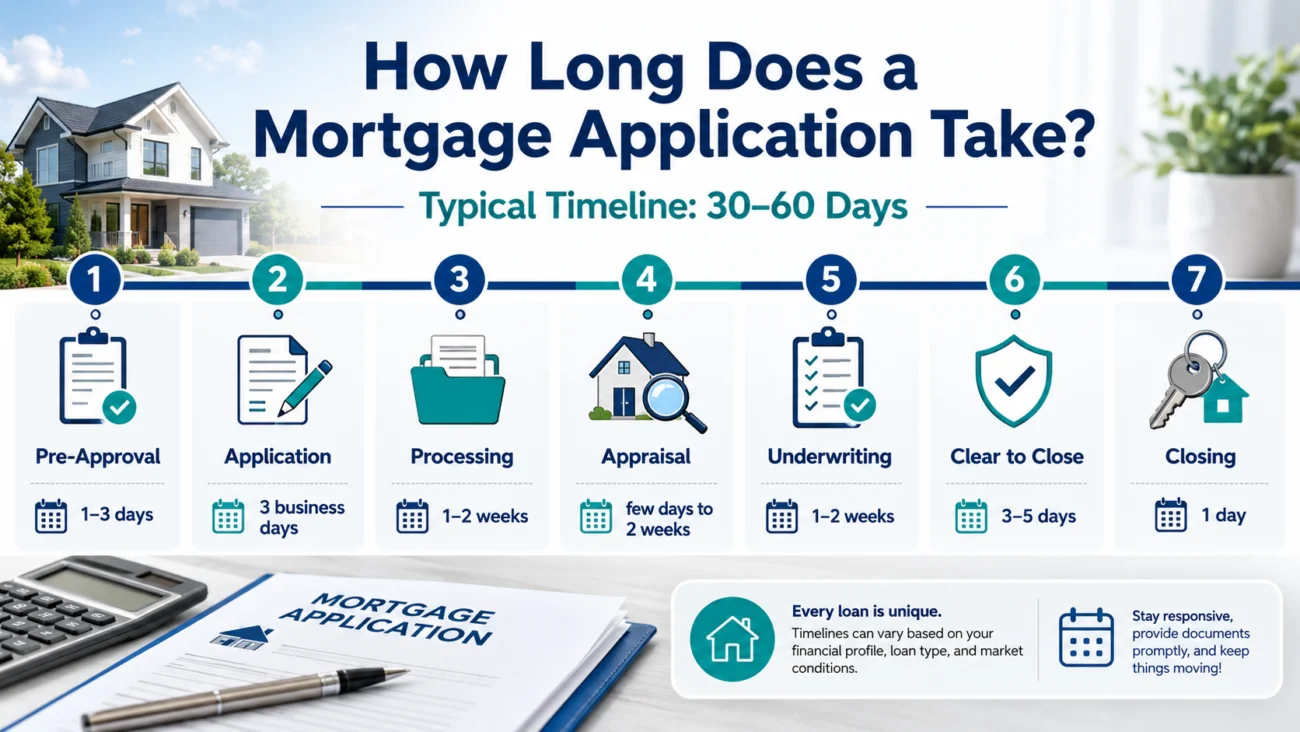
A clear mortgage application timeline showing the main stages from pre-approval to closing.
Mortgage Timeline by Loan Type
Different loan types can move at different speeds.
| Loan Type | Typical Timeline | Why Timing May Differ |
|---|---|---|
| Conventional loan | 30 to 45 days | Often faster for strong borrowers with complete documents |
| FHA loan | 30 to 60 days | Property standards and borrower rules may add review |
| VA loan | 30 to 60 days | VA eligibility and appraisal requirements may affect timing |
| USDA loan | 30 to 60+ days | Rural property rules and agency review may add time |
| Jumbo loan | 45 to 60+ days | Larger loan amounts usually require deeper review |
| Refinance | 30 to 45 days | May be faster if appraisal and title are simple |
These are general estimates. A simple FHA loan can close faster than a complicated conventional loan. A refinance can be delayed if title or income issues appear. The borrower’s situation matters as much as the loan type.
How Long Does Underwriting Take?
Mortgage underwriting can take a few days, but it may take several weeks if the file is complex.
Underwriting is usually faster when:
- Credit is strong
- Income is stable
- Documents are complete
- Debt-to-income ratio is comfortable
- Appraisal supports the value
- Title is clean
- Down payment source is simple
Underwriting is usually slower when:
- Income is self-employed or variable
- Bank deposits need explanation
- Credit history has issues
- Debt-to-income ratio is high
- Appraisal is delayed or low
- Title has problems
- The loan is jumbo or non-standard
Here is a simple view:
| Situation | Likely Impact on Timeline |
|---|---|
| Complete documents | Faster |
| Missing documents | Slower |
| Stable salary income | Faster |
| Self-employed income | Slower |
| Clean title | Faster |
| Title issues | Slower |
| Strong credit | Faster |
| Credit disputes or late payments | Slower |
| Appraisal completed quickly | Faster |
| Low appraisal | Slower |
How to Speed Up a Mortgage Application
You cannot control every part of the mortgage process, but you can control more than you may think.
Get Pre-Approved Early
Do not wait until you find a house to speak with a lender. Pre-approval gives the lender time to review your financial profile before you are under pressure to close.
It can also help you:
- Understand your budget
- Find credit issues early
- Prepare documents
- Estimate monthly payments
- Make stronger offers
- Avoid surprises later
Prepare Your Documents Before Applying
Create a mortgage folder before you apply.
Include:
- Government-issued ID
- Last 30 days of pay stubs
- Last 2 years of W-2s
- Last 2 years of tax returns, if needed
- Last 2 months of bank statements
- Investment account statements
- Retirement account statements
- Current debt information
- Landlord or mortgage history
- Gift fund documentation, if applicable
- Business documents, if self-employed
Having these documents ready can save several days.
Respond Quickly to Lender Requests
When your lender asks for a document, send it as soon as possible. If you do not understand the request, ask for clarification right away.
Do not ignore conditions. Many mortgage files slow down because the borrower waits too long to respond.
Avoid Financial Changes
Before closing, avoid:
- New loans
- New credit cards
- Large purchases
- Job changes
- Moving money between accounts
- Large cash deposits
- Co-signing loans
- Missing payments
Keep your financial profile stable until the mortgage closes.
Keep Communication Simple and Organized
Use one email thread or lender portal when possible. Label your documents clearly.
For example:
- January Bank Statement
- February Bank Statement
- 2025 W-2
- Gift Letter
- Homeowners Insurance Quote
- Updated Pay Stub
This makes life easier for your loan officer, processor, and underwriter.
Shop for Homeowners Insurance Early
Many borrowers wait too long to arrange insurance. The lender usually needs proof of homeowners insurance before closing.
Start comparing insurance options soon after your offer is accepted.
Questions to Ask Your Lender About the Timeline
To stay on track, ask direct questions.
Useful questions include:
- What is your current average application-to-closing timeline?
- Has my appraisal been ordered?
- Has my file gone to underwriting?
- Are there any missing documents?
- Are there any open conditions?
- Is the title work complete?
- When should I expect final approval?
- When will I receive the Closing Disclosure?
- Is my closing date still realistic?
- What could delay my loan right now?
These questions help you understand whether the process is moving normally or falling behind.
How to Know Your Mortgage Application Is on Track
Your mortgage application is usually on track if:
- The lender has your documents
- The appraisal has been ordered
- The title search has started
- Your file has been reviewed by underwriting
- Conditions are clear and specific
- You have provided requested documents for mortgage application uk
- Homeowners insurance is arranged
- Closing costs are being finalized
- The Closing Disclosure is being prepared or issued
Warning signs include:
- No updates for several days
- Repeated requests for the same document
- Appraisal has not been ordered
- You do not know whether underwriting has started
- Conditions are unclear
- Title issues remain unresolved
- Closing Disclosure has not arrived close to the closing date
If you see these warning signs, contact your loan officer and ask what step is holding up the process.
Can a Mortgage Application Be Approved in One Week?
A mortgage pre-approval can sometimes happen very quickly. A full mortgage application and closing in one week is much less common.
Why?
Because a full mortgage usually requires:
- Full document review
- Appraisal
- Title search
- Underwriting
- Insurance verification
- Closing Disclosure
- Final signing
Some lenders have fast systems, and some files are very clean. Still, most financed home purchases need more than one week because several steps depend on third parties.
Can a Mortgage Application Take Longer Than 60 Days?
Yes. A mortgage application can take longer than 60 days when the file has complications.
Common reasons include:
- Self-employed income review
- Credit problems
- High debt-to-income ratio
- Missing documents
- Low appraisal
- Required repairs
- Title issues
- Slow insurance documents
- Borrower changes jobs
- Borrower opens new credit
- Lender backlog
- Complex loan type
If your loan is taking too long, ask your lender:
- What is the exact reason for the delay?
- Is the delay related to me, the property, the appraisal, title, or underwriting?
- What document is still needed?
- Who is responsible for the next step?
- Can the closing date still be met?
- Is there anything I can do today?
Final Takeaway: How Long Should You Expect?
A mortgage application usually takes 30 to 60 days from full application to closing. Pre-approval may happen much faster, but the complete mortgage process requires more review.
The biggest timeline factors are:
- Borrower document readiness
- Lender speed
- Underwriting complexity
- Appraisal timing
- Title search results
- Insurance documents
- Loan type
- Borrower financial stability
The fastest mortgage applications usually come from borrowers who prepare early, submit complete documents, respond quickly, avoid new debt, and work with a lender that communicates clearly.
Frequently Asked Questions
How long does a mortgage application take from start to finish?
A mortgage application usually takes about 30 to 60 days from full application to closing. Some loans close faster, while complex files may take longer.
How long does mortgage pre-approval take?
Mortgage pre-approval can take the same day to a few business days if your documents are ready and your financial profile is straightforward.
How long does underwriting take?
Underwriting may take a few days for a simple file, but it can take several weeks if the lender needs more documents, explanations, or third-party information.
What is the longest part of the mortgage application?
The longest parts are often underwriting, appraisal, and title review. These stages involve detailed checks and may depend on third parties.
Why does my lender keep asking for more documents?
Lenders must verify your income, assets, debt, credit, employment, and down payment funds. Extra requests usually happen because the underwriter needs more proof before final approval.
Can I speed up my mortgage application?
Yes. Get pre-approved early, prepare your documents, respond quickly, avoid new debt, keep money movements simple, and stay in contact with your lender.
Does a mortgage application take longer for self-employed borrowers?
It can. Self-employed borrowers often need more documents, such as tax returns, business bank statements, profit-and-loss statements, and income explanations.
What does conditional approval mean?
Conditional approval means the lender may approve your loan after you provide specific remaining documents or explanations.
Can my mortgage be denied after pre-approval?
Yes. Pre-approval is not final approval. A loan may still be denied if your credit, income, debt, employment, appraisal, title, or property details do not meet lender requirements.
What should I avoid during the mortgage process?
Avoid opening new credit, buying a car, financing furniture, changing jobs, making large cash deposits, missing payments, or moving money between accounts without speaking to your lender.